Ligjet e logjikës se gjykimeve

Nga Wikibooks

Shko te: navigacion, kërko
Jeni duke lexuar pjesë nga libri në punim e sipër:
Algjebra e përgjithëshme

Shkalla UNI
Konceptet dhe simbolet e logjikës matematike
Gjykimet

Bashkësitë
Relacionet
Pasqyrimet
Veprimet binare
Grupi
Unaza, Trupi dhe Fusha


Rëndom në algjebër p, q, r, \ldots quhen gjykime fillestare ose themelore . Kur në këto gjykime p, q, r,\ldots veprojmë me veprime themelore logjike : \lnot  , \land , \vee  , \veebar , \Rightarrow  , \Leftrightarrow marrim gjykime të përbëra të trajtave: \lnot  p , p \land q , p \vee  q , p \veebar q , p \Rightarrow  q , p \Leftrightarrow  q , p \land \lnot  q ,  p \vee  \lnot  p , (p \Rightarrow  q) \land \lnot  q \Rightarrow  \lnot  p , (p \Rightarrow  q) \Leftrightarrow  ( \lnot  q \Rightarrow  \lnot  p)  , etj. të cilat quhen formula gjykimesh . Vlera e saktësisë së një formule gjykimesh provohet duke formuar tabelen e saktësisë së veprimeve themelore logjike.

[redaktoni] Tautologjia

Formulat e gjykimeve të cilat janë të sakta për çdo vlerë të gjykimeve fillestare quhen tautologji ose ligje logjike. Kur ndonjë formulë gjykimesh është tautologji, para saj shënohet simboli Tautologji.PNG .

[redaktoni] Ligji i kontrapozicionit

Të provohet saktësia e formulës (p \Rightarrow  q) \Leftrightarrow  ( \lnot  p \Rightarrow  \lnot  q), e cila shpreh ligjin e kontrapozicionit.
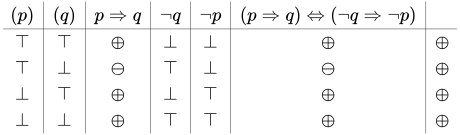

	\begin{array}{c|c||c|c|c||c||c}
	(p) &(q) &p\Rightarrow q & \lnot q  & \lnot p & (p\Rightarrow q) \Leftrightarrow (\lnot q\Rightarrow \lnot p)  \\
	\hline
	\top & \top 	& \oplus 	& \bot & \bot 	& \oplus  	& \oplus \\
	\top & \bot 	& \ominus	& \top & \bot 	& \ominus 	& \oplus \\
	\bot & \top 	& \oplus 	& \bot & \top 	& \oplus 	& \oplus \\
	\bot & \bot 	& \oplus 	& \top & \top 	& \oplus  	& \oplus \\
	\end{array}

shihet se formula e dhënë është tautologji Tautologji.PNG, d.m.th është e saktë për çdo vlerë të gykimeve fillestare.

[redaktoni] Rregulla e silogjizmit

Të provohet tautologjia Tautologji.PNG  {(p \Rightarrow  q)} \land (q \Rightarrow  r)(p \Rightarrow  r) , e cila shpreh ligjin logjik të quajtur rregulla e silogjizmit

Nga tabela e formuar:


	\begin{array}{c|c|c||c|c|c|c||c}
	p & q & r & p\Rightarrow r & q\Rightarrow r & (p\Rightarrow q)\land (q\Rightarrow r) & p\Rightarrow r & (p\Rightarrow q)\land (q\Rightarrow r)\Rightarrow (p\Rightarrow r) \\
	\hline
	\top & \top & \top  	& \top	& \top  & \top 	& \top		& \top	\\
	\top & \top & \bot  	& \top  & \bot	& \bot	& \bot  	& \top	\\ 		
	\top & \bot & \top  	& \bot 	& \top 	& \bot 	& \top 		& \top	\\
	\top & \bot & \bot  	& \bot 	& \top 	& \bot 	& \bot 		& \top	\\
	\bot & \top & \top  	& \top  & \top 	& \top	& \top 		& \top	\\ 
	\bot & \top & \bot  	& \top  & \bot 	& \bot	& \top 		& \top	\\  
	\bot & \bot & \top  	& \top  & \top 	& \top	& \top 		& \top	\\ 
	\bot & \bot & \bot  	& \top  & \top 	& \top	& \top  	& \top	\\ 
	\end{array}

konkludohet se rregulla e silogjizmit është e saktë për çdo vlerë të gjykimeve fillestare, andaj ajo është tautologji .

Tautologji janë edhe formulat :

  • (a1) (p \land q) \land r \Leftrightarrow  p \land (q \land r)  ;
  • (a2) (p \vee  q) \vee  r \Leftrightarrow  p \vee  (q \vee  r)  ;
  • (a3) p \land (q \vee  r) \Leftrightarrow  (p \land q) \vee  (p \land r)  ;
  • (a4) p \vee  (q \land r) \Leftrightarrow  (p \vee  q) \land (p \vee  r)  ;

që shprehin ligjet se veprimet \land , \vee janë asocijative dhe ato janë distributive njëri ndaj tjetrit.






